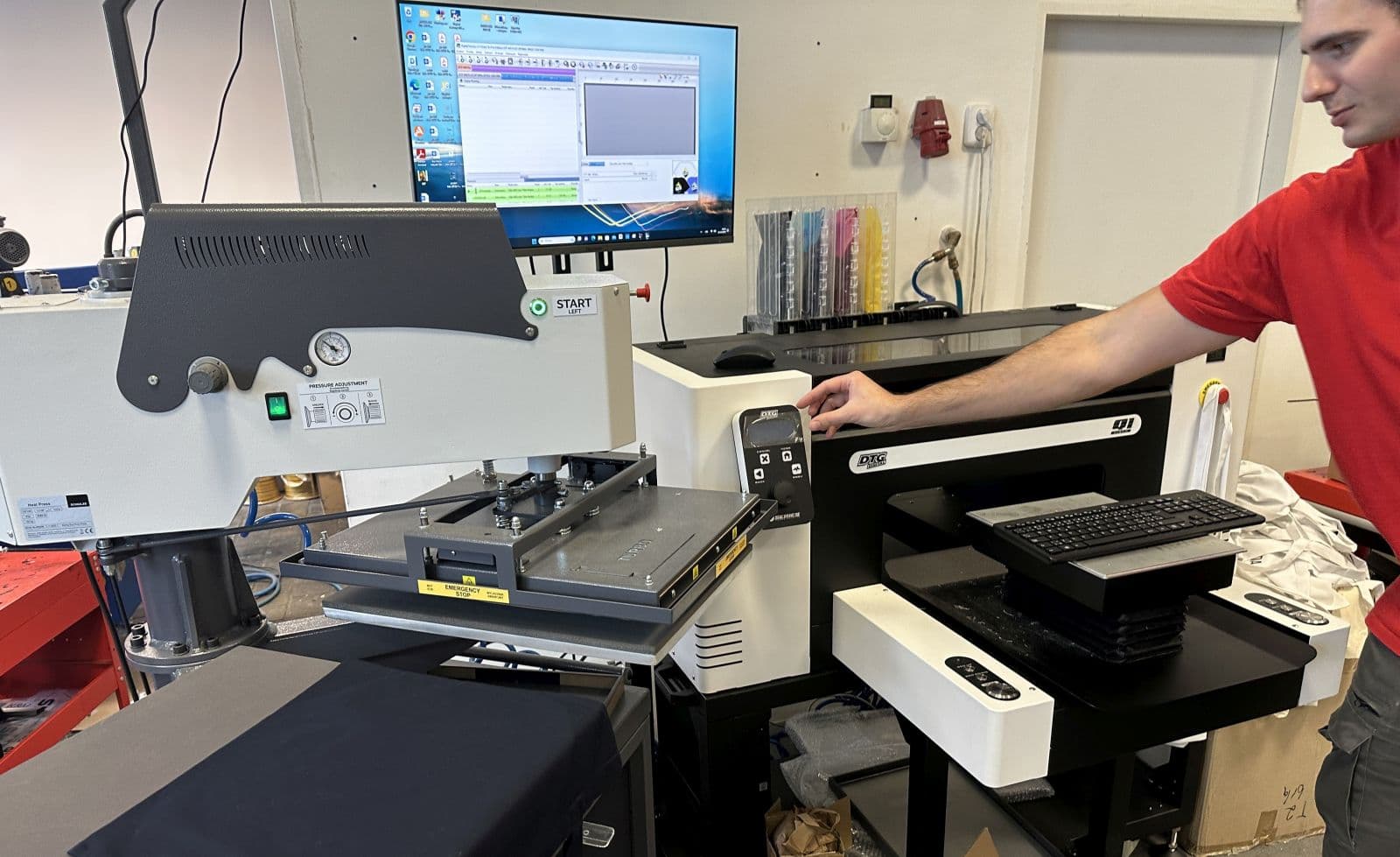
What is DTF printing?
Direct-to-film printing is a relatively new technique that is growing in popularity. DTF prints offer excellent colour accuracy and detail, are durable and look fantastic. Other advantages of DTF printing include low production costs, a wide range of colour options and the ability to print on both dark and light-coloured bags. It is also generally suitable for various types of materials, such as polyester, cotton, nylon and fleece.
- full-colour digital printing with eco-friendly ink
- colour accuracy, vibrancy and durability
- smooth and flexible print with a long lifespan
- printing on both dark and light-coloured bags
- ideal for printing photographs, colourful patterns, graphics and fine art
- low production costs##
Although the process may seem time-consuming and involves several steps and actions, the printing time per bag is only a few minutes. Here are the basic steps of DTF printing:
- The design is printed onto a special transfer film using water-based inks
- The ink on the film is then coated with a special adhesive powder
- The result of this process is DTF transfers – finished, printed and powder-coated films, which are then
- transferred onto the fabric using a heat press.
- The design is transferred to the fabric using a heat press

What is DTG printing?
Direct-to-garment printing is a method in which ink is sprayed directly onto a fabric bag, enabling high-quality, full-colour prints. DTG prints are soft, breathable and very durable.
DTG printing is best suited to fabrics such as cotton, bamboo and other natural materials, as the material absorbs the ink. DTG is one of the most popular printing methods in on-demand manufacturing.
How does DTG printing work?
Unlike DTF printing, DTG requires fewer steps to print a design:
- First, a pre-treatment is applied to the bag to help the ink bond with the fabric
- The bag is then secured to a platen and the design is sprayed onto the fabric using water-based inks
- The ink is then cured to make the print more durable
The main advantage of DTG printing is that it is easy to print single items, as almost no set-up time is required. Printing a single fabric bag takes just a few minutes and production costs are also low.

DTG vs. DTF printing: what are the differences
? Although both printing methods may seem quite similar, they do have some significant differences. Both methods produce stunning results, but there is more to them than meets the eye.
Print quality and durability
The print quality of DTF is excellent. Although the print has a raised texture and may feel slightly stiff at first, it softens after a few washes. Furthermore, DTF prints are smooth and elastic, ensuring a long lifespan. The prints are crack-resistant and can withstand heavy use and cold to lukewarm washing without the colours fading. However, washing fabric bags in very hot water may cause tiny cracks to appear in the design (we do not recommend this).
The DTF method is excellent for printing photographs, colourful patterns, graphics and fine art. The results will be stunning, as the ink does not soak into the fabric but is pressed onto the surface. The print is very thin, so it won’t feel bulky.
DTG printing also delivers fantastic print quality. A fresh print may feel slightly rough, but it will smooth out after a few washes. The print may feel slightly rubbery, but it does not feel uncomfortable to the touch. Usually, this won’t be noticeable at all.
The DTG technique is excellent for printing colourful patterns, graphics, text and more. These prints always look great, but the print result can be affected by certain factors. For example, as the fabric absorbs the ink, the print may appear less vibrant, particularly on a black or coloured bag.
If you follow the care instructions for your printed bag, the prints will last a long time. They won’t crack, peel or fade. You might be surprised at just how durable these prints are.
Complexity When it comes to print complexity, DTF prints are unrivalled. DTF printing supports photographs, detailed, full-colour designs, fine art, small text, graphics and more. The prints are sharp, bright and realistic, so they will closely resemble the original design. What’s more, you can print gradients. Bear in mind, however, that DTF printing (the final colour layer) is based on white ink, which may affect the gradients or transparency of your design.
DTG prints also support colour designs, graphics, photographs, fine art, small text and more. These prints are vibrant, bright and detailed. Bear in mind, however, that the fabric absorbs the ink, which may affect the brightness of the design. It is also difficult to print colour gradients using DTG, so you must ensure your design is suitable for this method.
Colour
vibrancy DTF printing uses primary colours (known as CMYK, or cyan, magenta, yellow and black) and white ink as its base. Every design will be vibrant regardless of the colour or type of fabric.
DTG printing also uses the CMYK colour model to print all designs. Prints also have a white base colour, but only if the design is printed on a black or coloured bag. The white base colour is not used when printing designs on white fabrics.
As the ink is sprayed directly onto the fabric, it soaks into the fabric. As a result, the prints may not be as bright or vivid as with DTF printing. Nevertheless, DTG produces stunning prints.
Fabric
Suitability One of the advantages of direct-to-garment printing is that you can print on a variety of fabrics. This flexible printing method can be applied to polyester, cotton, fleece, nylon and similar fabric blends. The material does not affect the print, giving you more design options for your brand.
Unlike DTF printing, DTG is best suited to natural fabrics such as cotton, bamboo, linen or similar fabric blends. This is because the ink bonds better with the natural fibres of the fabric than with synthetic fabrics.
Quantity
If you’re looking for a printing technique suitable for printing on bags to order, DTF printing is an excellent choice. It’s possible to print on just one bag or place a bulk order for bags; it therefore suits a made-to-order production model well.
The same applies to DTG technology – it is ideal for both small and large orders. DTG is one of the most popular printing methods amongst dropshipping companies, as it is easy to use this printing technique for as many items as you need.
Environmental friendliness
If you are looking for a sustainable fulfilment method, DTF printing is a good choice. This technique allows you to print single-off items, so you won’t have to worry about unsold stock. The ability to produce products on demand also eliminates overproduction. The inks used in direct-to-film printing are water-based and non-toxic, making them environmentally friendly.
The transfer film used for the design is usually recyclable, so the printing process generally produces no waste.
DTG is also a good choice if you’re looking for an environmentally friendly fulfilment method. As with DTF printing, you can also print on a made-to-order basis using the DTG technique. Producing products on demand eliminates overproduction, as you can order exactly the quantity of products you require.
On-demand
production DTF and DTG printing are good on-demand production techniques. It is possible to order just one or more items, and the price remains the same (with the exception of bulk orders, where you may be eligible for a discount).
Initial investment
If you wish to print the bags yourself, you’ll need to factor in the cost of a DTF or DTG printer, test products, DTG or DTF inks and other fulfilment materials. However, you should consider whether such a significant investment is worthwhile when you can have the bags printed with your designs by us.

DTF and DTG printing: which printing process is best suited to which designs?
After thoroughly examining each printing method, it is clear that both deliver stunning results and are well-suited to on-demand printing businesses. However, each printing method produces a different result, which can either enhance or ruin your design. Let’s recap the individual techniques.
When to choose direct-to-film
printing DTF technology is worth trying if your designs are detailed and colourful, and it is important that your graphics are of the highest quality when printed. DTF prints are always vibrant and sharp. They are also durable and long-lasting.
However, if you want to print a large design – say, a photograph – this printing technique may be a poor choice. This is because DTF prints are not breathable, which means that printing a large design makes the bag less comfortable to carry for long periods.
Before ordering DTF-printed bags, you can always order a single sample for yourself to compare the same design produced using different techniques.
When to choose direct-to-garment (DTG) printing on fabric bags
If you want to offer cotton bags or products made from other natural materials, the DTG technique will be the best choice. Using this method, you can print on cotton bags with complete peace of mind.
You can also use the DTG technique if your designs are particularly complex. For example, if you have text, a logo or graphics. However, DTG also supports colour images and designs. Just bear in mind that the prints may not be as bright or sharp as with DTF printing.
Prints directly onto the bag are hard-wearing, durable and great for printing larger designs, as they are breathable. Just make sure you follow the care instructions for your fabric bag.
It’s one of the most popular printing methods in the world, so you can’t go far wrong with direct-to-bag printing. You can try this technique depending on your needs and designs, and see if the result meets your expectations.

Revolutionary DTF transfer printing on cotton bags
In 2023, we installed a new, revolutionary DTF (digital transfer) printing technology for printing on cotton bags, to complement our DTG (direct-to-garment) technology. The advantage is the fantastic elasticity of the print, which is pleasant to the touch and highly durable.
- full-colour digital printing with eco-friendly ink
- colour accuracy, vibrancy and durability
- smooth and flexible print with a long lifespan
- printing on both dark and light-coloured bags
- ideal for printing photographs, colourful patterns, graphics and fine art
- low production costs